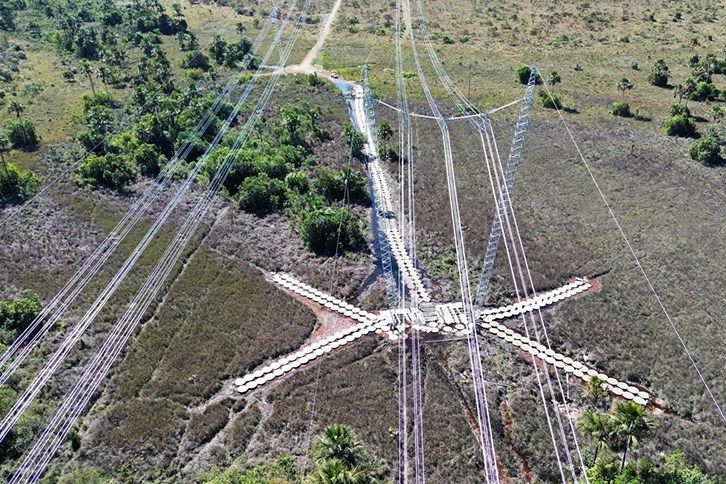
Neoenergia is entering the final phase of the major Alto Paranaíba project, one of Brazil’s largest electricity transmission initiatives, which crosses the states of Minas Gerais and São Paulo. The company has completed all the foundations and erected 99 % of the towers, with 3,217 structures erected out of the 3,244 planned.
Completing the foundations in an initiative of this magnitude is a significant achievement that demonstrates the soundness of the planning and the dedication of the teams on the ground. The foundation process – essential to ensuring the stability, safety and strength of the infrastructure for decades to come – involves deep excavations, high-precision concreting and the installation of fittings capable of supporting tonnes of metal structure for each of the towers, adapting the work to the different types of soil along the route.
Cable laying is also progressing at a good pace, with 78 % of the work completed, representing 1,226 kilometres of the planned 1,573 kilometres.

Key data points: The growth forecast is 15.2% annually for the next 7 years. Scroll below to get more insights. This market report covers trends, opportunities, and forecasts in the smart city ICT infrastructure market to 2031 by type (smart grid, smart building, smart water network, smart healthcare, smart education, smart security, and smart transport), application (communication, transportation, express government, education, and others), and region (North America, Europe, Asia Pacific, and the Rest of the World)
Download free sample pagesIn total, the construction project is now 93 % complete. Neoenergia expects to complete all the work necessary for the commissioning of this infrastructure, which is essential for Brazil’s energy future, by the end of this year.
Alto Paranaíba will contribute to the security and reliability of Brazil’s National Interconnected System. The project, awarded to Neoenergia in the National Electric Energy Agency (ANEEL) transmission auction No. 01/2022, will increase the capacity of the grid between the northern region of Minas Gerais and São Paulo and the transmission of energy generated in the interior of the country.