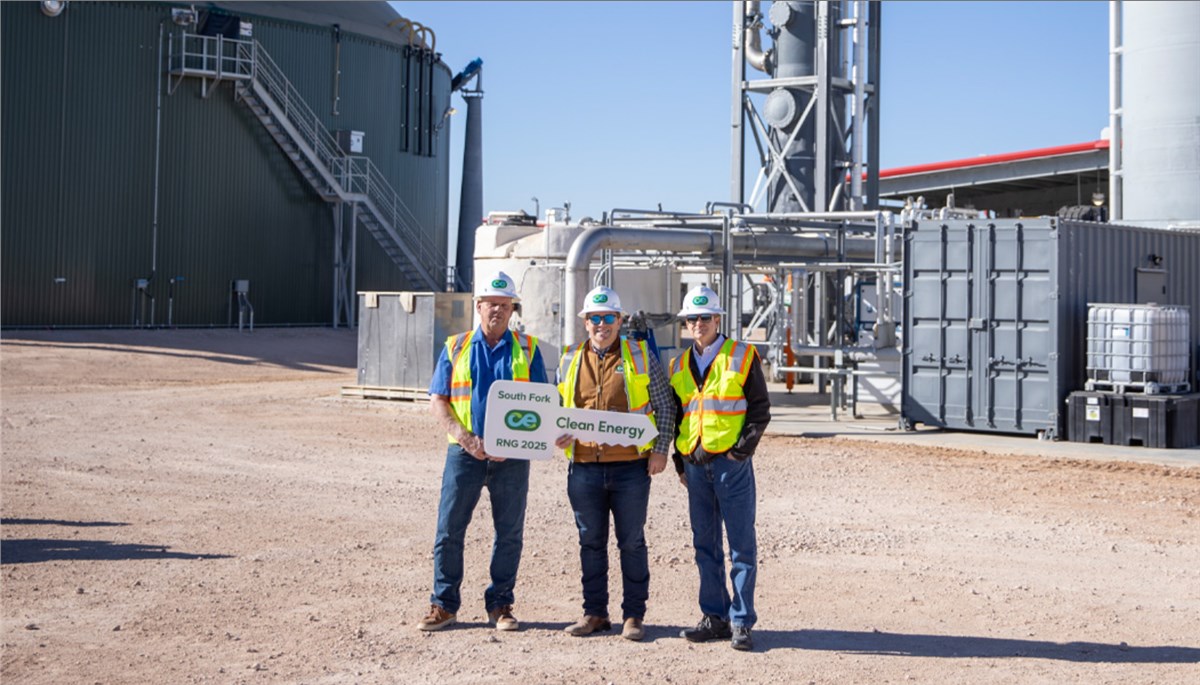
Clean Energy Fuels Corp. (NASDAQ: CLNE) has announced it has successfully completed its renewable natural gas (RNG) facility located at South Fork Dairy in Dimmitt, Texas. The facility is now producing pipeline-quality RNG and has begun injecting into the interstate natural gas pipeline.
Now one of the largest RNG production plants in the country, South Fork is home to a herd of 16,000 dairy cows and has the capability to produce approximately 2.6 million gallons of low-carbon RNG annually. The facility will process up to 300,000 gallons of dairy manure each day utilizing the four anaerobic digesters on-site, along with manure processing and advanced gas conversion equipment. The RNG produced is injected directly into an on-site gas line. Financed entirely by Clean Energy, the project broke ground in July 2024 and totaled $85 million. Clean Energy will receive 100 percent of the RNG fuel produced at South Fork Dairy.
“The requirements to reach production and injecting milestones were extremely stringent and we are incredibly proud of the team for getting our seventh RNG facility online, on time and on budget. It’s no small feat,” said Clay Corbus SVP at Clean Energy. “The completion of the project at South Fork is particularly special because not only is it a major step forward in building our low-carbon RNG supply to ensure we have the volumes needed to meet the growing fleet demand, but we were able to work side-by-side with such a remarkable dairyman in Frank Brand.”

by Filter Technology (Coalescer Filter, Cartridge Filter, Mechanical), Filter Media (Activated Carbon, Metallic, Synthetic Polymer), Application (Gas Processing Plant, Compression Stations, Storage & Distribution), Filtration Phase, and Region
Download free sample pages“Partnering with Clean Energy to build an RNG facility on the dairy has been a success for us,” said Frank Brand, owner of South Fork Dairy. “We’re processing our manure into useful bedding and producing clean, useful fuel for vehicles – it’s pretty amazing stuff. Being a part of something so circular that allows the dairy to reduce its emissions while providing an additional income stream is an added bonus.”
During construction, the project temporarily paused due to a fire that impacted the dairy. South Fork’s owner, Frank Brand, and his team rebuilt the dairy working closely with Clean Energy to navigate this. Today, both the dairy and the RNG facility are fully restored and operating – an outcome that is testament to the determination of the South Fork and Clean Energy teams.
The RNG produced at South Fork Dairy has received full approval from the U.S. Environmental Protection Agency (EPA) to begin generating Renewable Identification Numbers (RINs) under the Renewable Fuel Standard (RFS) program. Clean Energy also expects to generate California Low Carbon Fuel Standard (LCFS) credits in Q1, 2026. Clean Energy continues to expand its fueling network nationwide with over 600 stations RNG is delivered to.
T Diamond Bar and Montrose Environmental worked closely with the Clean Energy team to complete South Fork facility.
Agriculture accounts for nearly 10 percent of U.S. GHG emissions and the transportation sector accounts for another 28%, according to the EPA. Capturing methane from farm waste lowers these emissions. RNG, produced by that captured methane and used as a transportation fuel, significantly lowers GHG emissions on a lifecycle basis when compared to diesel. This allows RNG to be one of the only fuels to receive a negative carbon-intensity score based on the reduction of emissions at the source and at the vehicle and costs significantly less than diesel at the pump.