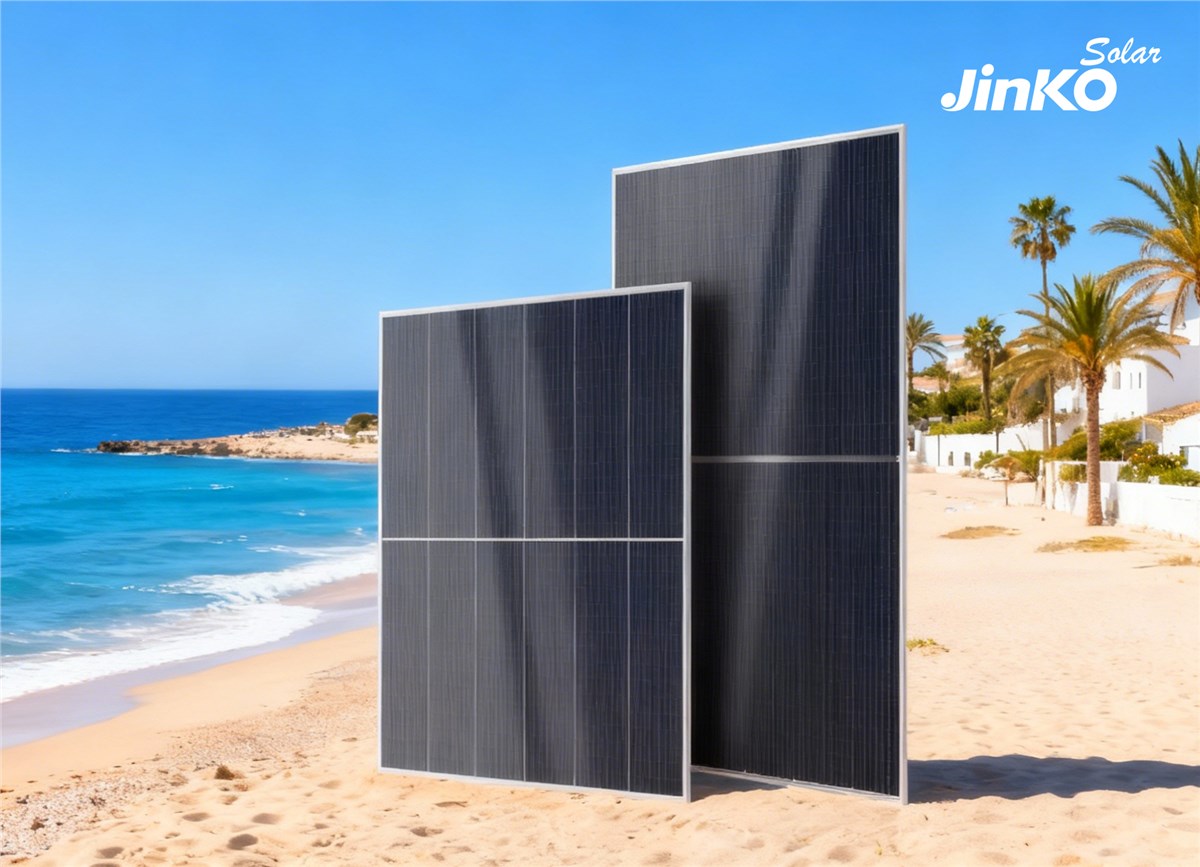
Recently, JinkoSolar successfully signed a supply agreement with a key Spanish partner for 309MW of its high-efficiency Tiger Neo 3.0 series photovoltaic modules. This order marks another major breakthrough for its new flagship 670Wp output plus 85% bifacility Tiger Neo 3.0 in Europe's utility-scale PV market. With its outstanding performance and reliability, the Tiger Neo 3.0 modules is emerging as the preferred solution for large-scale ground-mounted projects.
As a leader in Europe's PV market, Spain boasts unparalleled solar resources. However, its typical continental climate brings extreme summer heat, significant diurnal temperature variations, and an intense pursuit of lower Levelized Cost of Energy (LCOE). These factors impose stringent demands on PV modules' high-temperature power generation performance, long-term reliability, and system compatibility. The newly contracted Tiger Neo 3.0 modules precisely address the deep-seated needs of Spanish ground-mounted power plants through four core advantages based on N-type TOPCon technology:
1. High power density and reliability reduce plant BOS costs
The Tiger Neo 3.0 module achieves a peak efficiency of 24.8%, with front-side power output ranging from 660 to 670W. Higher power density means fewer modules, less mounting hardware, reduced cabling, and lower installation labor for the same installed capacity, effectively cutting plant BOS costs. Additionally, it has passed rigorous IEC standard testing and enhanced aging tests, demonstrating excellent resistance to PID, salt fog, and wind-blown sand. This enables it to confidently handle Spain's diverse surface conditions, ensuring long-term safe and stable plant operation.

by Material (Metal Based, Boron-Doped Diamond Based, Carbon Based, Polymer Based, Other Materials), Manufacturing Facility (Physical Vapor Deposition, Chemical Vapor Deposition, Sputtering, Electrochemical Deposition/Electroplating, Other Manufacturing Technology), End-Use Industry (Healthcare & Biotechnology, Electronics & Semiconductor, Energy & Power, Chemical & Petrochemical, Other End-Use Industries)
Download free sample pages2. Ultra-high bifaciality and ultra-low first-year degradation deliver optimal lifecycle value
Leveraging advanced N-type cell technology, the Tiger III module achieves an ultra-high bifaciality rate of 85%±5%, maximizing reflected light from surfaces like Spanish deserts and sandy terrain. This delivers an 8%-12% backside power gain in typical ground-mounted scenarios. Combined with its exceptional performance—first-year degradation <1% and linear degradation of only -0.35%—it ensures efficient, stable power output throughout the plant's 30-year lifecycle. This significantly reduces project LCOE and enhances investment return certainty.
3. Exceptional dual-mode power generation capability under both high temperatures and low irradiance, enhancing all-time gain.
Addressing the pain point of power degradation caused by Spain's summer heat, the Tiger Neo 3.0 module optimizes its power temperature coefficient to -0.26%/?, reducing power loss by approximately 1.5% compared to traditional modules in high-temperature environments. Simultaneously, its outstanding low-light response capability maintains 95%-98% relative power output during dawn, dusk, and cloudy conditions, effectively extending the plant's effective generation hours and delivering additional power generation benefits for the project.
4. Perfectly suited for large-scale power plant designs, compatible with mainstream tracking systems
The Tiger Neo 3.0module design prioritizes compatibility with common tracking mounts used in large-scale ground-mounted power plants. Its mechanical load capacity and resistance to microcracking risks have been optimized, enabling seamless integration with various tracking system solutions. This approach reduces system complexity while enhancing overall plant reliability and power generation efficiency.